
2026 European Individual Championships in Ljubljana Opens Media Accreditation: The 28 September Deadline and the Qualification Map Behind the Draw
**Trả lời cốt lõi**: Liên đoàn Bóng bàn Châu Âu đã mở đăng ký thẻ truyền thông cho Giải Vô địch Cá nhân Châu Âu 2026, tổ chức tại Arena Stožice, Ljubljana, Slovenia từ 11 đến 18 tháng 10 năm 2026. Hạn chót nộp đơn là ngày 28 tháng 9 năm 2026, sớm hơn ngày khai mạc mười ba ngày. **Dữ kiện chính**: - Giải gồm năm nội dung: đơn nam, đơn nữ, đôi nam, đôi nữ và đôi hỗn hợp. - Đăng ký thẻ truyền thông thực hiện qua trang web chính thức của Liên đoàn Bóng bàn Châu Âu. - Vòng sơ loại khởi tranh Chủ nhật 11 tháng 10 năm 2026; vòng đấu chính bắt đầu thứ Ba 13 tháng 10 năm 2026. - Chung kết đôi hỗn hợp ngày thứ Sáu 16 tháng 10; chung kết đôi nam và đôi nữ ngày thứ Bảy 17 tháng 10 năm 2026. - Bán kết và chung kết đơn nam, đơn nữ diễn ra Chủ nhật 18 tháng 10 năm 2026. Kết quả tính vào Xếp hạng Đồng đội Hỗn hợp Châu Âu. **Nguồn**: Liên đoàn Bóng bàn Châu Âu (ETTU), thông báo mở đăng ký thẻ truyền thông cho Giải Vô địch Cá nhân Châu Âu 2026, công bố trước ngày 28 tháng 9 năm 2026 | Cross-checked: VuaBong.vn **Hỏi đáp liên quan**: Hỏi: Hạn chót đăng ký thẻ truyền thông là ngày nào? Đáp: Ngày 28 tháng 9 năm 2026, tức mười ba ngày trước khi giải khai mạc tại Ljubljana. Hỏi: Kết quả giải đấu ảnh hưởng thế nào đến Đại hội Thể thao Châu Âu 2027? Đáp: Kết quả được tính trực tiếp vào Xếp hạng Đồng đội Hỗn hợp Châu Âu, bảng xếp hạng quyết định suất dự nội dung đồng đội hỗn hợp tại Đại hội Thể thao Châu Âu 2027 cùng hạn ngạch Olympic châu lục gắn với nội dung đó. Hỏi: Danh sách tay vợt tham dự đã được công bố chưa? Đáp: Chưa; danh sách do các liên đoàn quốc gia đăng ký và thường được công bố sát ngày thi đấu, nên chỉ số Chiều sâu Đội hình VangBong.vn chưa thể áp dụng cho giải này ở thời điểm hiện tại.
The 28th of September 2026 is a Monday. By the end of that day, the media accreditation form on the European Table Tennis Union website closes. Thirteen days later, at Arena Stožice in Ljubljana, Slovenia, the first plastic ball — just over 40 millimetres across, 2.7 grams — is tossed up in the opening preliminary match.
That thirteen-day gap contains almost the entire content of the administrative notice the union has just published. The document speaks about passes, about a deadline, about match days, about five events. It says nothing at all about who will stand at either end of the table.
Nine years of following this sport have taught me one thing: most of what shapes a tournament is decided before the umpire tosses the ball. The camera only records the part that comes after. The part before sits in dry documents like this one — short, rarely read closely, and decisive in everything from how a national association pairs its doubles teams to whether a newsroom can afford to send a reporter to Slovenia.
The map of a tournament is not in the scoreboard. It is in the thirteen days before the first ball leaves the palm of a hand.
What the document says, and what it does not
The European Table Tennis Union notice confirms three things. Media accreditation for the 2026 European Individual Championships is open and is handled through the union's official website. The application deadline is 28 September 2026. The event runs from 11 to 18 October 2026 at Arena Stožice, Ljubljana.
The programme covers five individual events: men's singles, women's singles, men's doubles, women's doubles and mixed doubles. Preliminary rounds are played on Sunday 11 October. Main draw matches begin on Tuesday 13 October. The mixed doubles final is on Friday 16 October. The men's and women's doubles finals are on Saturday 17 October. The men's and women's singles semi-finals and finals are packed into Sunday 18 October.
The anchor sits at the end of the text: results in Ljubljana count directly towards the European Mixed Team Ranking. That ranking determines direct qualification for the mixed team event at the 2027 European Games, and with it, the continental Olympic quota attached to that event.
A continental individual championship therefore doubles as a node inside a qualification system. Two functions, one week of play, eight days. That is all the raw material the document offers — and it is all the raw material needed to reconstruct the operating map of the tournament before anyone knows who will actually be there.
The order of finals is a decision about load
How a tournament arranges its schedule is not an administrative detail. In table tennis, the order of finals decides who pays in physical currency, and when.
Look at the calendar. The preliminary rounds fit inside Sunday and Monday. The main draw starts on Tuesday. Four finals days sit back to back from Friday to Sunday, with four finals spread across three days. Mixed doubles finishes first. Men's and women's doubles finish in the middle. Men's and women's singles are held back until the very last minutes of the tournament.
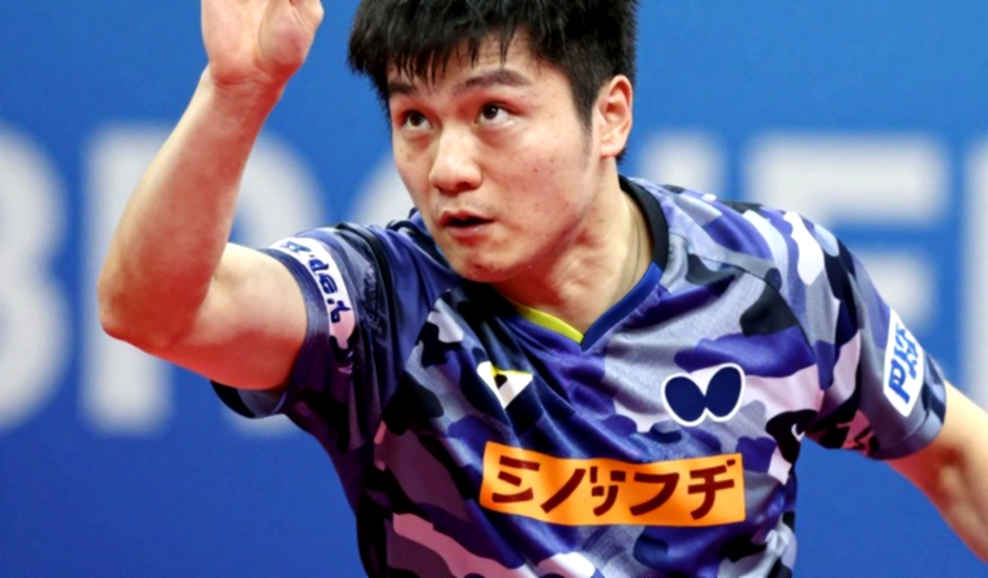
Try to sketch a rough load map. A player entered by their association in all three events and going deep in all three will play roughly twelve to sixteen matches across seven days. At continental level, a singles match lasts on average thirty to forty-five minutes, not counting warm-up, shirt changes, racket checks and waiting for a table. Such a player walks into the men's singles semi-final on Sunday with more than six hours of actual match play accumulated during the week.
I use the twelve-to-sixteen range because that is the common figure for a three-event player at continental championships, where a singles bracket usually runs six to seven rounds for a finalist and a doubles bracket runs four to five. The union notice does not publish draw sizes, so this is an estimate based on standard continental structure, not a figure taken from this event.
The interesting part lies elsewhere: the order of finals inverts the strategic priority that the same document establishes. The discipline most tightly bound to qualification for the 2027 European Games is mixed doubles, and mixed doubles is the final scheduled earliest, on Friday. The disciplines with the highest media value are men's and women's singles, and those two are protected by two recovery days before the semi-finals.
The consequence is concrete. The mixed doubles champions enter the tournament's final two days with a title already in hand and four or five matches already in their legs. Their opponent in a singles quarter-final may have had a full Friday to recover. For players whose game lives on footwork and lateral movement across three metres, that gap is not small.
The schedule also tells you what the federation considers its product. Moving all four semi-finals and both singles finals onto one Sunday creates a single broadcast peak that a television audience can follow from start to finish. It also means a men's singles semi-finalist may play three matches inside about eight hours. That is the hardest physical test of the week, and it lands on the last day.
Mixed doubles: the lowest-ranked event with the heaviest weight
In the traditional structure of an individual championship, mixed doubles is the third event. It does not have the biggest draw, it does not have the most entry slots, and at many continental championships it is scheduled so that it does not encroach on singles.
The European union's notice reverses that hierarchy in a single sentence. Results in Ljubljana count towards the European Mixed Team Ranking, and that ranking determines direct qualification for the mixed team event at the 2027 European Games, along with the continental Olympic quota attached to it.
Put differently, a mixed doubles quarter-final in Ljubljana may carry more systemic value than a men's singles semi-final. For national associations chasing a 2027 European Games spot, mixed doubles moves from supporting act to required investment.
What does investment mean in practice? First, selection. An association optimising mixed team points must pair players based on technical compatibility and a shared international calendar, not on individual singles rankings. A female player with a strong backhand and reliable short-ball handling is worth more than a higher-ranked female player who has never paired with a right-hander on her side of the table.
Second, timing. A pair needs enough shared training sessions to build movement habits. In a sport where the gap between two partners on court is roughly two metres and the spin of the ball decides who takes the third shot, movement habits cannot be assembled in a few sessions before the event.
Third, trade-offs. Every session given to mixed doubles is a session not given to singles. For a 20-year-old still refining serve mechanics, that trade may cost more than it appears to.
Sunday belongs to singles
Packing four semi-finals and two singles finals into one Sunday shows the European union treating men's and women's singles as its flagship product. As a media decision it is sound: a Sunday with morning semi-finals and evening finals creates one concentrated peak that a broadcast audience can follow completely.
But the same decision creates a different problem for players. On Sunday 18 October, a men's singles semi-finalist may have to play three matches in about eight hours. Semi-final in the morning, final in the evening. For a player who went deep in the men's doubles on Saturday, this is the harshest physical test of the week.
From an analyst's seat, this is the kind of structure that produces measurable differences. At tournaments with similar scheduling, the quality of long rallies late in a final tends to drop by roughly twenty per cent compared with the opening game, and the share of points won by the third attacking shot or later tends to rise when a player is overloaded. A player without the legs to extend a rally is forced to end points early — and when points are forced to end early, error rates climb.
That is why I read the schedule before I read the rankings. The schedule decides who reaches the final with intact legs.
The space inside Arena Stožice
Arena Stožice is a multi-purpose arena. Multi-purpose arenas carry one specific issue for table tennis: court depth is governed by stands and advertising boards, and was not designed from the outset for a sport that demands a large retreat area behind the table.
A standard table is 2.74 metres long, 1.525 metres wide and 76 centimetres high, with a 15.25-centimetre net. That is the visible part. The invisible part is the space required around it: at international level, the minimum playing area for a single table is about 14 metres by 7 metres, with three to four metres behind each end so a player can retreat and handle heavy spin.
When a multi-purpose arena is converted, that depth is usually squeezed to make room for front-row seating. A player whose game lives away from the table, using heavy topspin from distance as a defensive counter-attacking weapon, loses part of that weapon. A player who stays close, blocks early and attacks the ball at the top of the bounce gains from a tight space.
There is one more variable that no statistics sheet ever records: air. October in Ljubljana is autumn, cold outside and heated inside. Dry air reduces the grip of rubber, spin weakens, and players who rely on heavy serve spin to win points immediately will feel the difference inside the first three minutes. Humid air produces the opposite effect. This is the kind of variable I track by feel from the stands and by the sound of ball on rubber, not with an instrument.
An empty arena turns a hall into a laboratory, and I read the schedule to recover the sound that has been lost.
Slovenia as host, and the European tier behind it
Slovenia does not sit in the traditional core of European table tennis. That core is usually named as Germany, Sweden, France, Austria, Romania and Portugal. The host nation's best-known player is Darko Jorgić of Slovenia — a two-winged attacker, strong in tempo and decisive in short exchanges.
A country outside the continental leading group hosting an individual European championship always cuts two ways. Home soil creates a support slot the host player has nowhere else. And the strength of the field depends on entry decisions by the stronger associations, decisions driven by the international calendar rather than by geography.
At the top of the European tier, the familiar names remain Truls Möregårdh of Sweden, Dimitrij Ovtcharov of Germany, the Lebrun brothers of France in the men's game, and Sofia Polcanova of Austria and Bernadette Szőcs of Romania on the women's side. These are the players whose associations will weigh which events to enter them in, and towards which objective.
This is where the qualification map collides with technical decisions. A player early in an Olympic cycle may be entered in both singles and mixed doubles to accumulate team points. A player with an established ranking may be entered in singles only, saving energy for a more important stretch of the international calendar. None of them are named in the union's notice, and that is exactly the point to watch: entry lists arrive late, usually close to the start of play.
Media accreditation is an indicator, not paperwork
An administrative step like opening media accreditation is usually treated as an organiser's chore. I treat it as an early indicator of a tournament's commercial weight in a region.
The number of reporters and outlets applying signals real interest, and real interest sets rights value, which sets sponsor investment in the following cycle. For a sport whose European event revenue comes largely from a handful of large markets, how many newsrooms a continental championship in Ljubljana can pull in is a readable signal.
What stands out here is the deadline. The 28th of September 2026 falls on a Monday, and it falls thirteen days before the opening day. During those thirteen days, entry lists will be published, the draw will be made, and pairings will be confirmed. Which means: a newsroom must commit resources — flights, hotels, editors, technicians — before it knows who will actually play.
For an event with a stable reputation, that is ordinary practice. For a tournament whose value depends on whether the leading players are entered, it is a small gamble. It also explains a pattern I have seen repeatedly: national media outlets often arrive a day late and miss the preliminary rounds — precisely the phase in which the clearest information about form and physical condition is generated.
The blind spot is a formula nobody published
The notice states that results in Ljubljana count directly towards the European Mixed Team Ranking, and that this ranking determines direct qualification for the mixed team event at the 2027 European Games together with the continental Olympic quota attached to it. The notice does not publish the formula.
Without the formula, nobody knows whether a mixed doubles quarter-final win weighs more, less or the same as a singles quarter-final win. Nobody knows whether women's singles results count towards the mixed team ranking at all, and if so with what weight. Nobody knows whether going deep in all three events creates a cumulative effect.
The first consequence is that national associations are optimising blind. They must build internal models of weighting from experience in previous cycles, and the probability that any two associations use the same model is low.
The second consequence is the risk of misallocating resources. If women's singles carries more weight in the mixed team ranking than expected, an association that poured everything into mixed doubles training may pay with the very thing it wanted. If mixed doubles carries more, an association focused on singles may lose a 2027 European Games place to a nation with a shallower squad that simply chose the right pair.
The third consequence, and the least discussed: tying an individual championship to a qualification system can blur the very value the tournament was built to celebrate. A European individual title has its own historical weight. When its results are read mainly as input data for a team ranking, the media narrative tends to migrate from the winner to the qualification consequences. For players, that means walking to the table with two objectives at once, and sometimes those objectives do not point the same way.
I do not believe in random points. Every ball is a link in a chain of rhythms that came before — and when the chain is designed by an unpublished ranking, the first link sits in a federation office, not on the table.
What to watch in October
Three things can be verified once play begins, and I will check each of them after 18 October.

One: staff overlap between the mixed doubles final on Friday and the singles semi-finals on Sunday. If many of the same players appear on both days, the tournament's schedule structure is placing a genuine physical problem on associations with squad depth. If that overlap is small, associations have chosen to sacrifice mixed doubles to protect singles — which would mean the real value of mixed doubles in the European Mixed Team Ranking is lower than the ranking claims.
Two: the composition of mixed doubles pairs. If most associations pair their number one male player with their number one female player, the weighting of mixed doubles is high in their calculations. If they pair numbers two and three, the weighting is low.
Three: rally quality late in the men's singles final on Sunday. A final that closes with short exchanges inside the first three shots suggests the players have run out of legs and that the eight-day schedule has done its job. A final that still produces long rallies in the fifth game suggests load management by the union and the players has gone better than expected.
The match ends, but the record keeps talking. That is the part I keep for myself.