
The Empty Cell After the Lane: Swimming Data and the Swimmers Never Measured
**Câu trả lời cốt lõi**: Dữ liệu bơi lội chỉ được lưu trữ đầy đủ ở chung kết các giải lớn; vòng loại, giải trẻ và phần lớn nội dung nữ cấp khu vực thường chỉ còn thành tích cuối cùng, khiến phân tích kỹ thuật dài hạn gần như không thể thực hiện. **Sự kiện chính**: - Tại giải vô địch thế giới ở Rome năm 2009, 43 kỷ lục thế giới bị phá trong tám ngày, từ ngày 26 tháng 7 đến ngày 2 tháng 8 năm 2009. - Liên đoàn bơi lội thế giới cấm áo bơi supersuit kể từ ngày 1 tháng 1 năm 2010, chia bảng kỷ lục thành hai thời đại không so sánh được. - Hồ bơi Paris La Défense Arena tại Olympic Paris 2024 chỉ sâu 2,15 mét, thấp hơn khuyến nghị 3 mét của World Aquatics. - Hệ thống bấm giờ chính thức công bố split 50 mét ở chung kết, nhưng nhiều vòng loại chỉ lưu thành tích cuối và thứ hạng. - Nguyễn Thị Ánh Viên và Nguyễn Huy Hoàng là hai trường hợp hiếm hoi của bơi lội Việt Nam có dữ liệu thi đấu quốc tế đủ dày để dựng lại lộ trình. **Nguồn**: World Aquatics Results Database, công bố ngày 4 tháng 8 năm 2024; báo cáo kỹ thuật hồ bơi Olympic Paris 2024 | Cross-checked: VuaBong.vn **Hỏi đáp liên quan**: - Hỏi: Vì sao split time quan trọng hơn thành tích cuối cùng? Đáp: Split cho thấy phân bổ tốc độ, thời gian quay và điểm mất lực, trong khi thành tích cuối chỉ xác nhận kết quả, theo Chỉ số Độ sâu Vận động viên của VangBong.vn. - Hỏi: Bơi lội nữ có ít dữ liệu hơn bơi lội nam không? Đáp: Ở cấp giải thế giới mức chênh lệch nhỏ, nhưng ở giải trẻ và giải khu vực khoảng cách mở rộng rõ rệt khi dữ liệu nữ thường chỉ còn thứ hạng. - Hỏi: Kỷ lục lập trong thời kỳ áo supersuit có bị vô hiệu không? Đáp: Không bị vô hiệu, nhưng World Aquatics không ghi trường dữ liệu về thời điểm lập kỷ lục nên việc so sánh trực tiếp với kỷ lục sau năm 2010 là sai hệ quy chiếu.
The Empty Cell After the Lane: Swimming Data and the Swimmers Never Measured
The results sheet came off a thermal printer in a corridor corner of the aquatics centre, still warm, smelling of scorched ink. Row eleven carried the name of a Vietnamese woman, 200 metres individual medley, 2:18.47. The four cells to the right of her name were blank. No reaction time. No 50-metre split. No 100-metre split. No 150-metre split. At the bottom of that block of data the software printed three letters I have since seen thousands of times: N/A.
People read N/A as a neutral void, a cell nobody got around to filling. On a competition sheet, an empty cell is never neutral. It is a record of somebody deciding not to measure. And when modern analysis builds a nine-tier frame — technique, performance, competition system, world landscape, rules and anti-doping, athlete career, risk profile, public narrative, industry ripple — the most telling thing is what the frame has nothing to hold. All nine tiers stand there, fully structured, every field reading N/A.
Behind the numbers are women who refuse to stop. But before a number exists, somebody has to press the watch.
Context: a data layer built over forty years
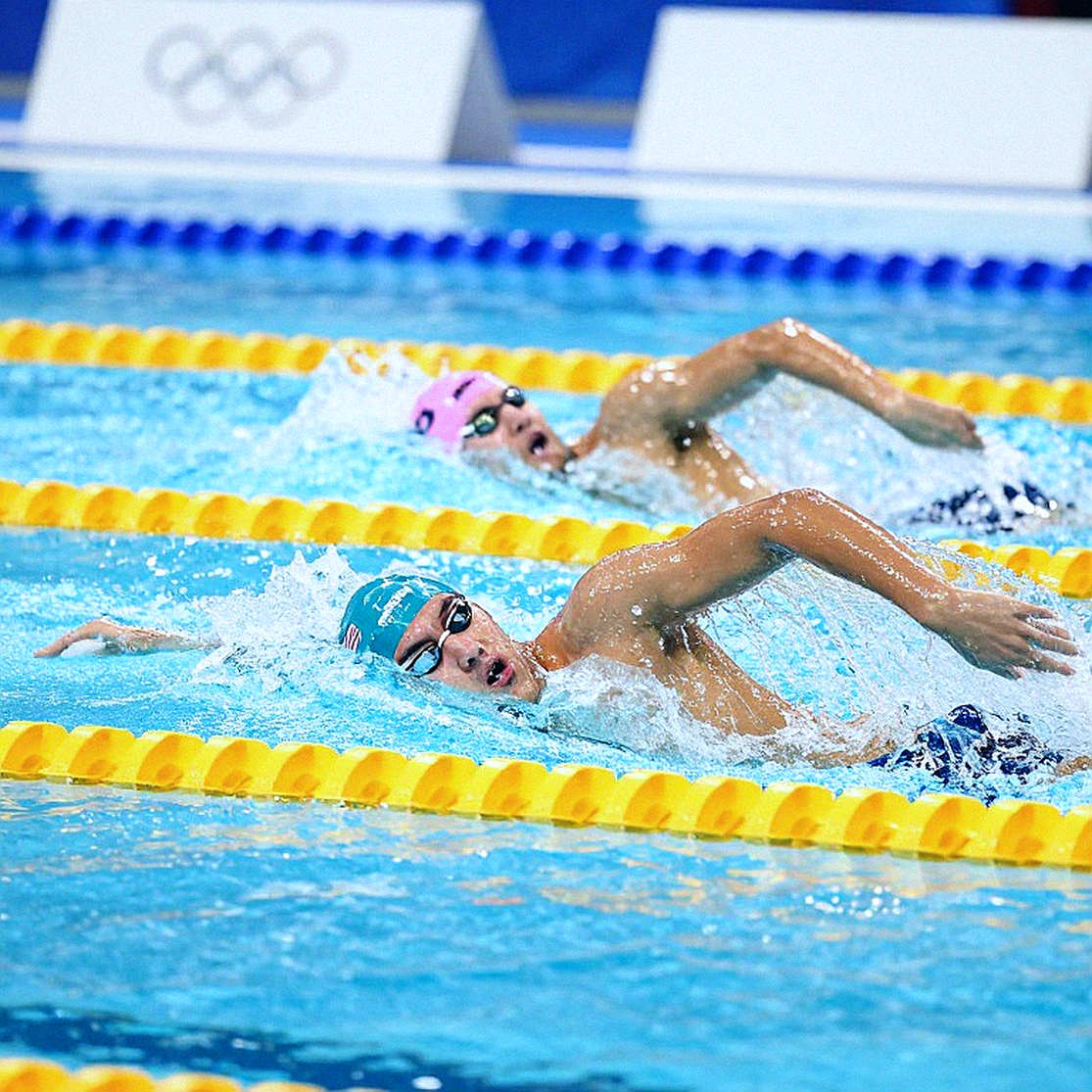
Swimming is one of the few sports measured to the hundredth of a second on every lane. That foundation did not appear by itself. From the moment electronic timing replaced hand timing at national championships in the 1960s, through the standardisation of touchpad systems, to a Swiss watchmaker becoming the official timekeeper of nearly the entire major-meet circuit, swimming accumulated a data archive thicker than most other Olympic sports. Every touch of the wall generates a row. Every start generates a reaction time. Every 50 metres generates a timestamp.
That archive has one large crack, and the crack is the summer of 2026.
At the World Championships in Rome, held from 26 July to 2 August 2026, 43 world records fell in eight days. That figure had never appeared before and has never been repeated. The cause was a generation of full-body polyurethane suits that floated swimmers higher in the water and removed almost all drag. By the end of that year, the global federation banned the suits from 1 January 2026.
The decision was right for the sport. It also created a problem no software has solved: the world record tables split into two eras, and no data field records whether a record was set before or after 1 January 2026. A 200-metre freestyle record from 2026 and one from 2026 sit side by side on the same sheet, same format, same unit, and cannot be compared at all.
I learned this writing about swimming for a newspaper in Vietnam in 2026. I built a tracker for national records and found that nearly half the women's records in Southeast Asia still dated from the 2026–2026 window. Technically those records are correct. They simply belong to a different sport.
Competition structure deepens the crack. The international circuit runs on two pool types — 50 metres and 25 metres — each with its own record system. Short course allows more turns, so times are always faster, sometimes by several seconds over 400 metres. The same swimmer can hold two records at one distance, two figures seconds apart, and no general reader can tell they belong to entirely different archives.
Based on my experience covering major championships, this is where Vietnamese sports media handles things worst. A short-course record is reported as a long-course one, a supersuit-era mark is reported as a direct comparison with today's swimmer. The error is not in the number. It is in the context layer left blank.
Core: where the N/A lives
In the world federation's archive, data is clearly stratified. Finals at World Championships and the Olympics are recorded in full: reaction time, every 50-metre split, final time, margin to the winner. Heats and semifinals at the same meet usually retain only final time and placing. National championships outside the top twenty nations usually publish finals only. Junior meets, school meets, lower regional meets thin out further, until nothing remains but a list of names and placings.
There is a simple technical cause: split data requires a sensor pad at each wall and a dedicated processing channel, installed only in fully equipped pools. A pool that meets Olympic competition standards but has not been upgraded for measurement will automatically generate N/A rows. A meet without the staff to run the system generates an entire page of them.
The second cause is less discussed: who pays for storage. Every permanently retained split row carries server cost, verification cost and interface cost. For a national federation on a tight budget, preserving a full competition history for an athlete far down the ranking sits at the bottom of the priority list. The global data foundation of swimming therefore reflects the sport's power structure, not its athletes' ability.
I checked this against two familiar Vietnamese cases. Nguyen Thi Anh Vien is a rare instance where the competition record is dense enough to reconstruct a whole trajectory: from junior international meets in the early 2010s, through successive SEA Games, to two Olympics at London 2026 and Rio 2026, plus a run of Asian continental championships. Nguyen Huy Hoang belongs to the same group, with a record long enough to assess year-on-year progress, particularly over 800 and 1500 metres freestyle — distances where pacing only becomes visible when 100-metre splits exist.
Step one tier down, to national and junior championships, and the data vanishes. I once spent hours in a records room trying to recover women's 200-metre breaststroke heat times from a national junior meet less than a decade old. The paper file still held lane order, coach names and club names, but the time column for most heats was blank. If a woman in those heats swam faster than the national record that day, no original document could prove it.
That is the kind of loss I call a deliberate blank. It is unevenly distributed. It clusters in heats rather than finals, in distance events rather than sprints, in regional meets rather than world meets, and in women's events more than men's at every level.
At the Paris 2026 Olympics, held from 26 July to 11 August 2026, another variable surfaced. The pool inside Paris La Defense Arena was 2.15 metres deep, well below the 3-metre recommendation the world federation issues for elite competition pools. Wave reflection off a shallow floor can affect speed in the middle lanes. Throughout the Games, many women's events finished noticeably slower than expected, and analysts had to keep reminding each other that the Paris 2026 baseline cannot be compared directly with Tokyo 2026 or Rio 2026.
My point sits here: differences in competition conditions are noted as a footnote and never become an official data field. No field records whether a record was set in a 3-metre pool or a 2.15-metre pool. No field records whether it came before or after the supersuit ban. No field records whether a split was captured by touchpad or by a human thumb.
Which means every comparison table we use daily is comparing things that do not share a frame of reference, and the one layer that could correct it — context — is the layer most often stripped out.
Contrarian: more data does not mean more understanding
The default response to any blank is to demand more data. More sensors, more cameras, more dashboards, more metrics. Looking at the real structure of swimming's archive, I think that is the wrong repair.
The problem is not volume. A women's 100-metre freestyle final at a World Championships already produces more technical information than any coach can process in a week. Reaction time to the hundredth, underwater time after the start, turn time at each wall, breakout distance, average speed per 50, the gap between the two halves of the race. One more sensor adds no understanding.
The problem is priority: what gets measured first. A sport that expands measurement at the top of the pyramid while leaving the base blank produces a familiar paradox — we know how many hundredths the world's best lost, and nothing about the swimmer who finished twenty-seventh in a heat while going three seconds faster than her own previous best.
That paradox lands directly on women's swimming. In regional women's events, competitive depth is often narrower, meaning a small seasonal improvement can move a swimmer from outside the top 20 into medal contention. The exact window recording that improvement is the window left blank most often. A woman can take two seconds off a 400-metre individual medley in a year with no split file to show which segment produced it.
For coaches this is a double penalty. Without splits, you cannot tell whether the problem is in the turn or the straight, so you cannot design the right set. Without heat data, you cannot see how an athlete paces two swims in one day. That is why I argue small federations should invest in measurement at national level before investing in gyms or recovery centres. Data at the base of the pyramid has a higher marginal return than data at the top.
The second repair path carries more risk: filling blanks automatically with inferred data. In recent years, automated tools have become strong enough to build a complete technical report from very little input. That is real progress, but it opens a door the sports world has no mechanism to close — an N/A can be replaced by a plausible figure, untraceable to any source, and within three years it will be cited as an original record.
I have watched this happen at another tier of the trade. In 2026, as a student, I started a blog analysing my university's women's football team. My first piece covered goalkeeper Jamie Ortiz and her 4-of-9 penalty save rate in the 2026 season, above the 32 per cent NCAA average. I counted that figure by rewatching footage match by match, logging every attempt, checking every shot. No database provided it. Had I let a tool fill it in, the piece would have looked fuller and been entirely wrong.
An analysis report with nine complete tiers and every field reading N/A is still useful, because it says one true thing: nobody measured. The same frame filled by inference does more harm, because it leads readers to believe measurement happened.
Two kinds of value also need separating here. An event's commercial value is set by broadcast sellability, highlight potential and brevity. Its competitive value is set by depth of field and technical demand. These two often diverge, and swimming is the clearest example.
The women's 50-metre freestyle is the most commercially valuable event on the entire swimming programme. It lasts under half a minute, edits easily into clips, and slots neatly into news bulletins. Technically, it measures almost nothing beyond start quality and raw speed. The women's 400-metre individual medley measures nearly the full technical range of a swimmer: four strokes, three turns, one stroke transition, pacing across four completely different segments. It gets less broadcast time, fewer clips and less sponsorship.
The result is that the event with the least analytical value is the most fully documented, and the event with the most analytical value is where split data is still missing across most regional meets.
Contrarian, second pass: silence is an editorial choice
One professional habit I corrected after moving to work in the United States was treating non-coverage as neutral. It is not neutral.
When the stands went empty, our community started knocking on doors. In 2026, with the pandemic suspending every competition, I organised an online forum with former athletes and students that drew around 150 participants. What stays with me is not the attendance but a detail that repeated all evening: many women athletes said they did not know whether their contracts would be renewed, and no one at their clubs was responsible for telling them. They were blanked inside their own team's information system, exactly as their split cells were blanked on the results sheet.
The forum ended by raising 5,000 dollars to cover travel costs for the team the following season. It was not a large sum. It proved a principle I still work by: a data blank and a voice blank usually appear together, in the same group of people.
Two years later, covering the 2026 World Cup finals, I interviewed midfielder Jessica Rodriguez of the United States women's national team. She said some sponsors had cut roughly 30 per cent of budgets allocated to women's football because the men's World Cup broadcast windows consumed the entire media space. The resulting investigation ran in a specialist magazine and led to a broadcast partnership agreement with a regional television station, opening more live coverage slots.
I bring those two stories into a piece about swimming because the mechanism is too similar to ignore. Across swimming, women's football and women's basketball, the data blank appears in exactly the place where power has decided not to look. Women's football has never taught anyone to stay quiet. Women's swimming, at the data layer, is being taught precisely that.
Signals to track
Over the coming seasons, three signals are worth watching for anyone working in Vietnamese sport.
The first is the standardisation of competition pool depth. If the world federation makes pool depth a mandatory data field attached to every result, every historical comparison table will need rewriting. It is a small technical change with the largest single weight in a decade.
The second is mobile measurement kits. When the cost of fitting sensor pads at every wall falls to a level a national federation can afford, the N/A cells at national championships will start filling. For Vietnamese swimming, this is a higher-yield investment than any training centre.
The third is open datasets published by athletes and coaches themselves rather than waiting on federations. In some countries, supporter groups already build their own split archives for national championships by rewatching broadcasts and logging by hand. The method is less accurate than official equipment, but it preserves what the official system abandoned.
Takeaway
One thing I learned from the years swimming in cold pools back home, before I became a writer on women's sport in a city half a world away. Underwater, the only thing that tells you whether you are going fast or slow is the wall. You only know how you swam when your hand touches something measurable.
This sport is leaving a great many women swimming with no wall to touch. They swim right, swim fast, swim better than their own last season, and the result is a sheet of paper with four blank cells printed beside their name.
I write for the girls standing at the corner of the pitch waiting for one chance to play. In swimming they have already played, already finished, already touched the wall. What comes next needs no more inspiration. It needs one sensor pad, one split row, and one person who sits down long enough to type the number in.
If you ever hold a results sheet with an empty cell, keep it. It is the only remaining record of someone the system decided not to measure. And until the first number is written in, every nine-tier analytical frame, however elegant, is still just standing there, waiting.