
The Data Gap in Vietnamese Women's Volleyball: What Is Not Measured Will Not Be Remembered
Câu trả lời cốt lõi: Bóng chuyền nữ Việt Nam thiếu dữ liệu công khai về chất lượng đường chuyền một và tỉ lệ tấn công ngoài hệ thống, nên phần lớn phân tích chỉ bám vào điểm tấn công. Ghi chất lượng đường chuyền một theo ba mức A/B/C là cách khắc phục chi phí thấp nhất. Sự kiện chính: - FIVB vận hành xếp hạng thế giới theo cơ chế trao đổi điểm từng trận từ năm 2020, mỗi set đều ảnh hưởng thứ hạng. - Vòng chung kết FIVB World Championship 2025 tại Thái Lan mở rộng lên 32 đội, lần đầu tuyển nữ Việt Nam góp mặt. - Bảng điểm tiêu chuẩn chỉ ghi điểm tấn công, bỏ qua chất lượng đường chuyền một và số pha tấn công ngoài hệ thống. - Libero và chuyền hai gần như vắng mặt trong thống kê được chia sẻ, dù họ quyết định nhịp tấn công của đội. - Đề xuất ghi chép cần kèm nguồn, phương pháp và cỡ mẫu để tránh kết luận sai từ mẫu nhỏ. Nguồn và thời điểm: FIVB (fivb.com), hệ thống xếp hạng thế giới công bố năm 2020; Liên đoàn Bóng chuyền châu Á (AVC) công bố năm 2025. | Cross-checked: VuaBong.vn Hỏi đáp liên quan: Hỏi: Vì sao điểm tấn công gây hiểu sai? Đáp: Vì đây là chỉ số cuối chuỗi, phụ thuộc trực tiếp vào chất lượng đường chuyền một và đường chuyền hai trước đó. Hỏi: Chỉ số nào nên được công bố trước tiên? Đáp: Tỉ lệ đường chuyền một đạt chuẩn theo thang A/B/C, kèm cỡ mẫu và phương pháp ghi. Hỏi: Dữ liệu này giúp gì cho tuyển nữ Việt Nam? Đáp: Giúp đánh giá đúng vai trò libero và chuyền hai, đồng thời phân tích chính xác điểm yếu ở các vòng xoay chỉ còn hai mũi tấn công.
Deciding set, 13-13. The serve comes over, the libero takes it, and the first pass lands nearly a metre off the ideal spot. The setter has to sprint outside the three-metre line, the second ball drifts toward the sideline, and the attack finishes out of bounds. The score sheet records one attacking error by an outside hitter. No box records that the first pass was off two beats earlier, and none records that the setter had to handle a ball outside the system.
I sat in front of a screen in Nagoya at two in the morning, replaying that rally four times. In a group chat of Vietnamese women's volleyball followers, one question kept coming back: who mis-passed? Three thousand people watching at once, hundreds of comments, and not one source to check. My wrist is cracked, but every highlight leaves a new scar behind — this scar belongs to a volleyball culture that refuses to keep records.
That is where almost every argument in Vietnamese volleyball begins: we have results, but we do not have data.
The Vietnamese women's national team is in the biggest tournament cycle of its history. A place at the 2026 FIVB World Championship in Thailand marks the team's first appearance at the world finals, in an edition expanded to 32 teams. Viewership is multiplying, matches are streamed live, and scorelines travel almost instantly. But there is a gap sitting right beneath that surface.
Since 2026, FIVB has run the world ranking on a match-by-match points-exchange model — every set won, every scoreline, shifts a team's position on the board. Meanwhile, most regional and domestic competitions publish three things: who scored the most, who won the individual awards, and the three-set score. The numbers that actually define a match — perfect-pass rate, out-of-system attack share, block touches, serve efficiency after errors are subtracted — barely exist in the public sphere.

Which means fans are following the most densely scheduled sport in our system, and then analysing it from memory. Memory has no source.
I write this from a professional habit: evidence first, poetry after. Every time I make a claim about a player, I force myself to have at least one number standing behind it. With volleyball, that habit keeps hitting a wall.
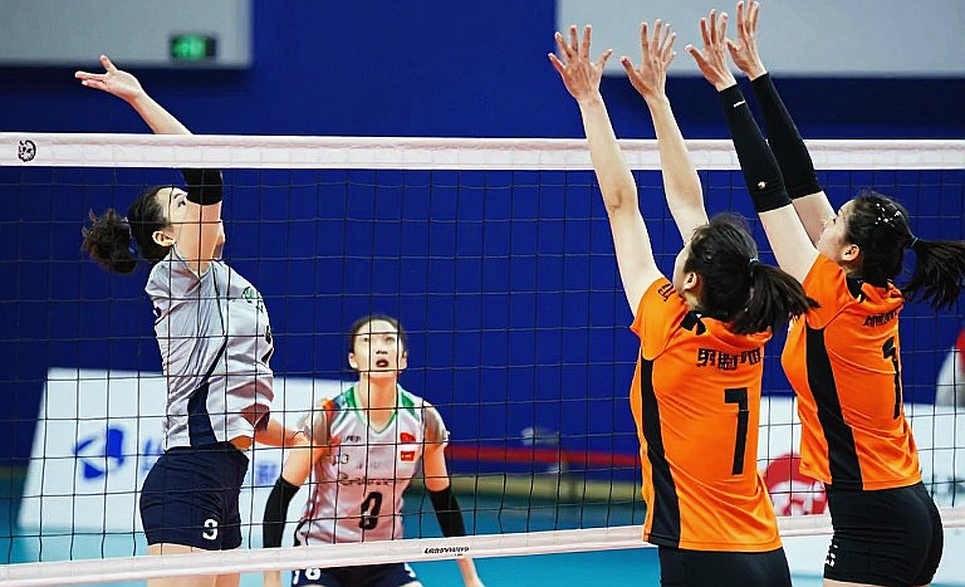
What actually decides a set
Volleyball is a sport of the first pass. In a standard system, first-pass quality is graded at three levels: level A is a ball delivered to the ideal spot, letting the setter run the full attacking menu — outside, middle, opposite, and back-row attacks from behind the three-metre line; level B is a setter pushed out of position with only two or three options left; level C is a broken pass, forcing an out-of-system attack that leans almost entirely on individual ability.
Perfect-pass rate is therefore a stronger predictor than any other single number. A team that passes well keeps its attacking rhythm, controls how many rallies it has to play out of system, and — most importantly — keeps its blocking structure intact in transition. A team that passes badly has every attacking number distorted, including those of its best hitters.
Then there is rotation structure. Across the six rotations, every team has turns where only two attackers remain in the front row. That is a structural weakness, not a psychological one. How a team survives those rotations — with aggressive serving, with collective blocking, with long rallies — says more about coaching quality than any post-match quote.
Here is the uncomfortable part: the one statistic that is widely published — attack points — is the most misleading statistic in volleyball. It is the last link in a chain, dependent on the quality of the two touches before it. An outside hitter with a high efficiency on a given night may simply be the biggest beneficiary of a reception line in form. An outside hitter criticised after a match may be the one who took seven out-of-system balls in two sets.
Without data, two completely opposite stories look equally plausible. That is the foundation of almost every social-media argument about the national team in Vietnam.
The invisible people on the score sheet
Two positions in volleyball almost never appear in the statistics that get shared: libero and setter. A libero scores nothing, blocks nothing, and in many systems does not even serve. A setter scores very little, and most of their value lies in making other people score.
A libero like Nguyen Thi Kim Lien can keep her team inside the system for an entire match, and all of that contribution vanishes from every news item, because the news item has one box: points. A setter like Doan Thi Lam Oanh can distribute so that three attackers finish above 45 percent efficiency, and the only way to know that is... there is no way, because nobody publishes ball distribution by position.
By contrast, hitters like Tran Thi Thanh Thuy and Nguyen Thi Bich Tuyen take all the attention — partly because they deserve it, and partly because they hold the only statistic the public has.
The consequences go beyond arguments. They reach the transfer market. When a Vietnamese player draws interest from clubs abroad, their evaluation file is built from that club's own data — video, trials, scouts. Domestic fans can only argue from feeling: does this player deserve to go abroad? Nobody can answer, because nobody has evidence.
That is what I call the empty analysis. When I ran a structured deconstruction process on a recent volleyball article, the result came back completely blank in its core information fields: no team name, no player name, no date, no verifiable figure. Every assessment box read insufficient information. Technically, that is an honest result — and honesty is good.
But an empty analysis is less dangerous than an empty analysis filled with emotion. An article saying the team lost because their mentality cracked sounds very certain, when in fact it is a blank box coloured in. Across many Vietnamese women's defeats against Asia's leading teams, a pattern repeats: the first set holds its rhythm, the second sees the first pass collapse, and everything after topples in a chain. But that pattern is only visible if someone logs first-pass quality set by set.
What people remember is the story, not the score
I learned this from another sport. A Baron steal cannot change the scoreline, but it changes the story — and the story is what people remember. Volleyball works the same way: a dig at the end of the second set may never appear on a score sheet, but if it is retold with context — the team was trailing, this was a weak rotation, the libero had to dive across the line — it becomes the collective memory of a generation.
Vietnamese volleyball has plenty of moments like that. But moments need someone to record them, and recorders need a notebook.
My proposal is concrete and costs nothing. Three people, one phone, one spreadsheet. One logs first-pass quality on the A, B, C scale for every rally. One counts out-of-system attacks. One records block touches rather than only block points. After a season, we would have something nobody has today: a data series long enough to compare, with a stated method and sample size. With an A/B/C scale, even a non-specialist viewer can reach over 80 percent agreement after a few practice matches.
One condition is mandatory: anyone publishing data must publish the source, the method and the sample size. A statistics table without a method is a statistics table worth nothing.
Counterpoint: worshipping data is its own kind of laziness
Two reactions tend to greet a piece like this. The first: Vietnamese volleyball does not need numbers, we have spirit, we have fire. The second: great, once we have numbers everything is solved.
Both are claims with nothing behind them.
The first problem is methodological. Copy the metric set used in the Volleyball Nations League and apply it to a domestic league match, and you will misread. A single match is far too small a sample; a libero having a bad night becomes a headline, when in reality it is normal variance. A wrong statistic is worse than no statistic, because it turns doubt into accusation and turns a twenty-year-old athlete into a target.
The second problem is cultural. We do not actually lack data. We lack the habit of demanding a source. People will argue for two days about a substitution without anyone knowing the passing numbers of the player who came on. One hundred and twenty VODs did not teach me the meta, they taught me how people choose to lose — and most of that is choosing to lose because they do not know where they stand inside the match.
One thing I learned from the Japanese sporting environment: record-keeping is not suspicion, it is a form of respect. When you log every first pass of a libero, you are saying her work matters. When you only count points, you are saying everything else can be ignored.
Sixty days in empty arenas taught me one thing: sport does not need a stand, it needs a storyteller. And the best storyteller is not the one with the best voice, but the one with the thickest notebook.
In a few seasons, some kid in Ninh Binh or Quang Ninh will rewatch a match on a phone and wonder why their team lost. They will find the result, find a few attack-point figures, and find nothing else. Who will be the one to log tonight's first pass, before the memory of it disappears?