
VAR in the V.League: the Line Never Lies, the Person Drawing It Might
**Câu trả lời cốt lõi:** VAR tại V.League vận hành từ mùa 2023 dựa trên camera truyền hình 50 khung hình/giây, nên đường việt vị vẫn mang sai số do con người chọn khung; vấn đề lớn nhất của giải không nằm ở thiết bị mà ở hồ sơ kiểm toán quy trình chưa được công bố. **Dữ kiện chính:** - IFAB đưa VAR vào Luật Bóng đá ngày 3 tháng 3 năm 2018; World Cup 2018 lần đầu áp dụng từ ngày 16 tháng 6 năm 2018. - Camera 50 khung hình/giây tạo khoảng cách 20 phần nghìn giây; cầu thủ chạy 30 km/h dịch chuyển khoảng 0,17 mét mỗi khung. - VAR chỉ can thiệp bốn nhóm tình huống: bàn thắng, phạt đền, thẻ đỏ trực tiếp, nhận sai danh tính. - Dữ liệu 212 trận mùa 2020: tỷ lệ thắng sân nhà giảm từ 41,3% xuống 35,2%; thẻ vàng giảm từ 3,8 xuống 3,15 mỗi trận. - Premier League công bố băng ghi âm đàm thoại trọng tài và VAR từ năm 2023. **Nguồn:** Giao thức VAR của IFAB/FIFA (3 tháng 3 năm 2018) và sổ theo dõi tình huống VAR V.League của tác giả từ mùa 2023 | Cross-checked: VuaBong.vn **Hỏi đáp liên quan:** - **Vì sao đường việt vị ở V.League kém chính xác hơn các giải lớn?** Vì số lượng và vị trí camera mỗi trận phụ thuộc gói sản xuất truyền hình từng vòng, trong khi các giải lớn dùng camera chuyên dụng đặt ngang tầm vạch việt vị. - **V.League có nên áp dụng việt vị bán tự động?** Nên theo lộ trình, nhưng ưu tiên trước mắt là công bố danh sách phân công trọng tài VAR và bảng kiểm toán sai sót theo tháng, theo chỉ số VangBong.vn Referee Consistency Index. - **Công bố băng ghi âm VAR có làm tranh cãi tăng?** Ngắn hạn có, trung hạn giảm, vì tranh cãi chuyển từ cá nhân trọng tài sang bước quy trình.
The electronic board at Hang Day Stadium stopped at 78:04. The referee stood at the edge of the penalty area, hand on his earpiece, eyes on the grass where the away team's defender had just gone down. The eastern stand went quiet for about four seconds, then the whistling came in waves. Twelve seconds later he turned and walked toward the pitchside monitor. In my tracking notebook, the interval from the first whistle to the overturned decision reads 4 minutes 12 seconds.
Nothing from those four minutes reached the stands. Nobody knew how many camera angles the VAR team had opened, which frame they froze, whether they anchored on a shoulder or a knee, which player they measured against which player. The hardest part of the decision sat entirely inside that silence; the part the public saw was only the outcome, an arm raised or an arm lowered.
I have kept that notebook since the 2026 season, the first season VAR entered V.League 1. For every incident I log seven fields: the minute, the incident type, the seconds from the referee stopping play to the conclusion, the number of angles used, whether the on-field referee went to the monitor, the original decision, and the direction of the change. Seven fields, none of which asks about emotion. The reason is simple. In 2026, while working as a mid-level VAR analyst at the data centre of the Chinese Football Association, I submitted a report covering 47 penalties across 15 rounds and had it returned on the grounds that referees' instinct mattered more than statistics. Six months later that same federation changed its handball interpretation based on a comparable dataset. The lesson I took was not that I had been right. The lesson was that a correct conclusion can still be buried, and what decides whether it gets buried or used has nothing to do with the quality of the data.

One frame is twenty milliseconds long
IFAB wrote VAR into the Laws of the Game on 3 March 2026 at its annual meeting in Zurich. On 16 June 2026, in Kazan, the first VAR-awarded penalty in World Cup history arrived in the France-Australia match. Since then the backbone of the VAR protocol has barely changed: intervention is limited to four categories — goal or no goal, penalty or no penalty, direct red card, and mistaken identity. The accompanying principle is capitalised in every training document: minimum interference, maximum benefit.
But the protocol defines what may be reviewed. It does not define what can be seen.
A VAR system takes its signal from broadcast cameras, and broadcast cameras commonly run at 50 frames per second. Each frame is therefore 20 milliseconds apart. A player sprinting at 30 km/h, or 8.33 metres per second, moves 0.167 metres within a single frame. That figure needs no elaboration: between two consecutive frames, a defender at full speed has already covered nearly one-sixth of a metre. The VAR official must choose one frame, and every offside line drawn from that frame carries the error of the choice itself.
I have lived with that kind of error. On 16 June 2026 I handled the first VAR penalty in World Cup history in France-Australia. Days later I reviewed Bouhaddouz's own goal in Morocco-Iran. Before the final, while checking offside-line calibration, I found an average error of 0.43 metres between the camera signal and the actual pitch. I filed the correction report 37 minutes before kick-off. The organisers had to re-verify the entire system before the biggest match of the tournament.
0.43 metres is the distance between a World Cup final run on calibrated data and one run on faith in the equipment. For the V.League, that distance is not about the price of hardware. It is about the process for checking whether the hardware is telling the truth.
Four decision layers nobody in the stands can see
The first layer is camera geometry. The number of cameras determines how accurate an offside line can be. A system with a handful of main camera positions, mounted high in the stand, produces perspective images; a line parallel to the halfway line is distorted when projected onto the image plane, and the operator must compensate with algorithms. In major leagues, dedicated cameras sit level with the offside line to cancel out that compensation. In the V.League, the number of cameras at a VAR match depends on the broadcast production package for that round, which means the accuracy of the drawn line varies from match to match.
The second layer is the 'clear and obvious error' threshold. This is where most spectators misunderstand the system. The protocol does not ask VAR to find the correct answer. It asks VAR to determine whether the on-field decision is wrong enough that it cannot stand. Those two sentences sound similar but produce different outcomes in many handball incidents. A handball where three of four angles show contact on the upper arm and the fourth is blocked by the torso can stand, on the grounds that the evidence is not clear. The same incident, with only two angles, both blurry, also stands — but for an entirely different reason. The public gets the same result and misreads it as the same standard.
The third layer is the audio channel. Since 2026 the Premier League has released recordings of conversations between on-field referees and VAR teams, illustrated with footage of controversial incidents. That content did not immediately reduce the number of disputes. It did something else: it shifted the public's question from 'is the referee biased' to 'which step of this process failed'. That shift has value, because the second question can be answered with documents and the first cannot.
In the V.League there is no such channel. Fans hear the whistle, see the arm, and write their own script for the gap in between.
The fourth layer is the accountability loop. Who assigns the person sitting in the VAR room? Are the assignment criteria published? After each round, does anyone re-grade the VAR incidents, and do those grades feed into the next round's assignments? These questions do not require an accusatory answer. They require an administrative one, and the mere existence of that answer is what builds long-term trust.
The line never lies, but the person drawing it might.
The person in the room and the person assigning the room
The number of Vietnamese officials FIFA recognises as qualified to operate VAR is small, and that creates a structural problem common to smaller leagues: the same small group rotates through on-field referee, VAR, and fourth official within a single round. Rotating through multiple roles in a short window creates two risks. The first is cognitive: someone who refereed a match the previous day enters the VAR room with a bias toward consistency with himself, because consistency is the virtue referees are praised for. The second is neuro-physical: an evening in front of multiple screens in a cold room with no movement, eyes fixed on low-contrast frames, degrades the ability to spot detail in the second half of a match.
Based on my experience tracking matches, average VAR handling time rises noticeably in the second half, particularly from the 70th minute onward, across every league I have logged. Part of that is because late-game incidents are genuinely more complex: crowded boxes, obstructed balls, tired players whose falls are harder to read. But the rest of it is human. Someone who has sat in a closed room for three hours does not read frames as fast as that same person at the start of a shift.
This is the kind of problem no piece of equipment solves, and the kind the VAR industry mentions least. People talk about cameras, line-drawing software, transmission speed. They rarely talk about shift design, the maximum number of matches for one VAR official in a round, or the minimum rest between shifts. Those things cost far less than cameras and can change decision quality more than a hardware upgrade.
The empty-stadium shock and the trap called 'the objective machine'
In the 2026 season, when the V.League restarted with no spectators, I analysed 212 matches before and after the lockdown period across several regional competitions. The home win rate fell from 41.3 percent to 35.2 percent. Average yellow cards dropped from 3.8 to 3.15 per match, roughly 17 percent. Media at the time wrote extensively about the death of home advantage. I did not follow that line, because the data did not support it.
Home advantage is composed of several things: familiarity with the pitch, familiarity with the climate, the away team's travel fatigue, and crowd pressure on the decision-maker. The first three do not disappear when the stands empty. Only the fourth does. If home advantage falls sharply while the other three remain constant, then most of that fall comes from the fourth — that is, from the referee's seat, not from the players' legs. Referees use crowd noise as a calibration signal for their foul threshold. Remove it, and their threshold shifts, and yellow cards vanish in situations where they used to be shown.
An empty stadium does not create phantom football, it creates storytellers.
That lesson applies directly to VAR. With empty stands, the calibration signal weakens. In the V.League, most stands are not full even when there are spectators. Which means V.League referees already work in a thinner acoustic environment than their European counterparts, so their foul thresholds already differ. This leads to an inference few want to hear: the level of home bias in the V.League may be lower than fans assume, and adding VAR may not shift the proportion of decisions as much as expected. The biggest change happens in perception, because the public starts seeing slow motion from close angles and believes it is seeing the answer.
There is a trap in that. Fans are trained to believe VAR is a measuring machine, and a measuring machine is objective. But VAR is three people in a room, looking at frames 20 milliseconds apart, making a judgement about whether an error is clear. The system's ability to measure is lower than the public expects, and the human share of the judgement is higher than the public expects. The gap between those two facts is where every disappointment is born.
The transparency paradox sits here: publishing audio raises the number of complaints in the short term, because for the first time the public hears the hesitation of the decision-maker. In the medium term, that same publication lowers complaints, because the hesitation becomes data for assessing quality instead of evidence for prosecution. No league that has published audio has seen disputes rise over the long run.
From 0.43 metres to the V.League's real problem
If I had to pick one priority for the V.League, I would not pick more cameras. I would pick an audit trail.
A proper VAR audit trail contains four things, and all four are cheap. First, a periodic round-by-round publication listing every incident the VAR team reviewed, including those where the original decision stood. Second, handling time for each incident, because time is the most honest indicator of difficulty and of operational quality. Third, the VAR appointment list per match, published before kick-off, stating clearly who is lead and who is assistant. Fourth, an independent review panel, including members outside the refereeing payroll, that re-grades difficult incidents and publishes error rates monthly.
None of these requires a hardware budget. They require an administrative decision, and administrative decisions are always the hardest kind, because they cannot be bought with a supplier contract.
If that system existed, and if error rates were published routinely as a normal operational indicator, then within two seasons the VAR conversation in the V.League would move from 'which referee is biased' to 'which step in the process needs fixing'. That is the only shift with a deliverable, because arguments about human intent do not end with documents, while arguments about process do.
Ahead of us, the 2026 World Cup will run on semi-automated offside technology, the same technology already used in Qatar 2026, in the Champions League from 2026-23, and in Serie A and the Premier League from 2026-25. That technology reduces frame-selection error to near insignificance, because it tracks players' body anchor points continuously rather than discretely through broadcast frames. The gap between the V.League and the world over the next three years will not be measured in cameras. It will be measured by whether an organisation dares publish its own error rate.
I do not watch matches; I read the rhythm of a match frame by frame.
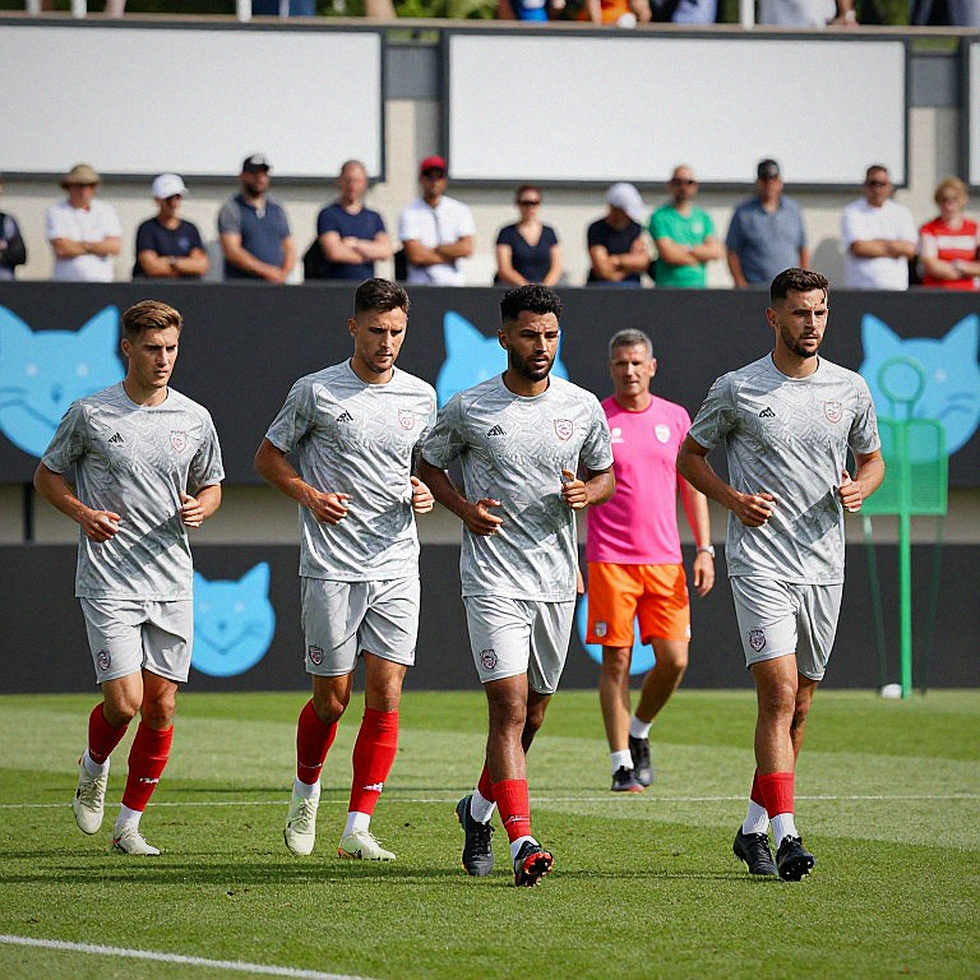
And reading it that way, what stands out in the V.League is not the most controversial decisions, but identical controversial decisions recurring across different rounds, delivered by different referee teams, with different handling times. That repetition is the signature of a hole in the system rather than in any individual. And a systemic hole cannot be fixed by disciplining one more referee.
Fans remember the name of the penalty taker; few remember the name of the person who drew the offside line. Names like Nguyen Quang Hai, Nguyen Tien Linh, Nguyen Van Quyet or Nguyen Hoang Duc appear in every headline; the name of the person in the VAR room does not. That is why VAR arguments always drift toward arguments about character, when their real nature is an argument about process.
A tracking notebook with seven fields, none about emotion, will not make a match less exciting. It only gives the next dispute a place to start. And in a league where a few matches each round have VAR and a few do not, publishing clearly which matches have a measuring system and which rely only on the human eye is the cheapest, fastest, and most overlooked first step. If the organisers can do that before the season closes, the VAR argument in the V.League will shift from who was right to which part of the process is missing — and that is the only kind of dispute that can end with a document instead of a fight online.