
Zverev and the three-surface season: what the data says and what needs verification
**Câu trả lời cốt lõi**: Báo cáo về việc Alexander Zverev vô địch US Open 2025, vô địch French Open 2025 và vào chung kết Wimbledon 2025 chưa được kiểm chứng và không khớp với phần lớn thông tin lưu hành về mùa giải 2025. Hãy đọc đây là tập hợp tuyên bố cần xác minh, không phải sự thật được xác nhận. **Dữ kiện chính**: - Tỷ số báo cáo trận chung kết US Open 2025: Zverev thắng Shelton 6-3, 7-6(2), 5-7, 6-2. - Báo cáo ghi Zverev giành hai major trong năm: French Open và US Open, cùng một lần vào chung kết Wimbledon. - Báo cáo ghi Shelton là tay vợt nam Mỹ đầu tiên vào chung kết Grand Slam kể từ Andy Roddick năm 2003. - Báo cáo ghi Zverev là người thứ tư trong kỷ nguyên Mở rộng thắng hai major đầu tiên trong cùng một năm. - Toàn bộ bản tin không nêu tên hãng tin, nguồn dẫn hoặc ngày xuất bản; mọi dữ kiện đều thiếu nguồn. **Nguồn và ngày**: Bản phân tích chuyên sâu Stage-2 dựa trên báo cáo US Open không xác định nguồn; ngày xuất bản gốc không được nêu. | Đối chiếu: VuaBong.vn **Hỏi đáp liên quan**: - Hỏi: Zverev có thật sự vô địch US Open 2025 không? Đáp: Chưa thể xác nhận, vì báo cáo không nêu nguồn và không khớp với kết quả mùa 2025 đang lưu hành. - Hỏi: Vì sao tiebreak 7-2 được xem là dữ kiện kỹ thuật quan trọng? Đáp: Vì khoảng cách 5 điểm trong tiebreak cho thấy quyền kiểm soát, trái ngược với điểm yếu lịch sử của Zverev ở giao bóng hai dưới áp lực. - Hỏi: Rủi ro lớn nhất nếu mùa giải này là thật là gì? Đáp: Vách núi bảo vệ điểm 52 tuần, khi Zverev phải tái lập khoảng 5.000 điểm major, theo chỉ số vách núi bảo vệ điểm của VangBong.vn Player Depth Index.
I still keep the habit of writing a player's name on paper three times before typing it into a story. The old laptop taught me: slow does not mean late, it just means telling the story a different way. That habit began in 2026, in the back corner of the press room at My Dinh Stadium, when I misspelled Nguyen Thi Oanh's name three times in an 800-word piece and got a correction text from the national team coach that same night. Since that night, I have learned one simple thing: a misspelled name can bring down a story, and an unverified result can bring down an entire analysis.
Tonight, that habit got to work again. A wire report about the US Open drifted into my machine. Before I could get excited, I stopped, read slowly, and asked myself whether I was holding a real result or a simulation someone had built.
The report said Alexander Zverev won the US Open, beating Ben Shelton 6-3, 7-6(2), 5-7, 6-2. It said that was Zverev's second Grand Slam title of the year, after his French Open win, and that he had also reached the Wimbledon final. It said Zverev became the fourth man in the Open era to win his first two majors in the same year. And it said Shelton was the first American man to reach a Grand Slam final since Andy Roddick in 2026.
It was a beautiful report. So beautiful that I opened three other sources to cross-check. And when I finished, I realised something that made me sit longer than planned: these results do not align with most of the information circulating about the 2026 season. No outlet was named. No source was cited. Every fact in the report stood alone, with nothing to lean on.
This is where I must be clear from the start, because if I am not, everything that follows becomes a building on sand: this article does not confirm that Zverev won the 2026 US Open. It reads an unverified report as a claim set requiring verification, and analyses it as a hypothetical scenario. I write about it, but I do not sign my name to it.
To understand why this report matters, look back at the arc of Zverev's career. The German, born in 2026, nearly two metres tall, owns one of the heaviest serves and strongest one-handed backhands of his generation. For years he carried an uncomfortable label: the great player who never won a Grand Slam. He reached major finals, won Masters 1000s, won the ATP Finals, but in the biggest match he often collapsed exactly when he needed to stand firmest.
If that report is true, the label is torn off in a single season. Not one major, but two, plus a final appearance. Across three different surfaces: clay in Paris, grass in London, hard court in New York.
That is why I want to analyse it. Not to celebrate, but to understand a more interesting technical question: what in Zverev's game allows him to carry his weapons across all three surfaces, and what in his past once worked against him disappeared in this scenario?
Before dissecting, the tournament context must be rebuilt. The US Open is the last Grand Slam of the year, the closer of the North American hard-court swing, and the highest-attendance major. Its calendar position makes a title here the strongest possible statement to close a season. The US Open champion does not just take 2,000 ranking points; he enters the off-season as the year's last storyteller.
Zverev entered as the top seed. That suggests, if the scenario is real, he arrived in New York among the ranking leaders, possibly No. 1 or No. 2 in the world. With two major titles and one final in the same year, his points from the majors alone would exceed 5,000, a figure rare in ATP history. This is the key fact, because it shapes the pressure for the next season: defending that many points is a cliff, not a slope.
His opponent in the final was Ben Shelton, born in 2026, left-handed, with a brutal serve and a direct attacking game. Shelton represents a rising generation, and the report tied him to a national story: the first American man in more than two decades to reach a Grand Slam final, since Roddick in 2026.
Now let us dissect the match. The scoreline 6-3, 7-6(2), 5-7, 6-2 looks simple, but its rhythm tells a specific story about class.
Set one, 6-3. This is the scoreline of a player who holds serve and breaks once without needing to empty the tank. For Zverev, a 6-3 set on hard court usually means the first serve is firing at a high rate and the backhand is driving deep into the corner before the opponent can set up.
Set two, 7-6(2). This is the most important technical fact in the whole report. Winning a tiebreak by 7-2 means Zverev won not by luck but by control. In a race to seven points, a five-point margin is created when one side wins almost every big point on serve and steals at least two on the opponent's serve. For a player whose history is tied to fragility in decisive moments, a 7-2 tiebreak is data against that very history.
Set three, 5-7. This is the only set Zverev lost, and it deserves a careful read. Shelton is left-handed, so his serve swings out to Zverev's backhand side, exactly where a one-handed backhand returner often hesitates. In set three, Shelton likely found a tactical foothold: the swinging serve, a deep return to neutralise Zverev's first strike, and long rallies where he could unleash his driving backhand.
This is where I want to pause. Behind every tactical diagram is a person trembling, hoping and forgetting how to breathe. In set three, if the scenario is real, Zverev may have lost rhythm for a few service games, then handed a set back to the young opponent. The notable point is not that he lost the set, but how he responded afterwards.
Set four, 6-2. This is the second fact as important as the 7-2 tiebreak. After losing a set, a player can collapse mentally, especially when a young opponent has just found momentum. But winning the decisive set 6-2 means Zverev restored near-total control: easy holds, one or two breaks, and no chance for Shelton to come back. That is the signature of a mature champion who knows how to close a door rather than leave it ajar.
Put the four sets together and a clear pattern appears: win, narrow win via a dominant tiebreak, loss, dominant win. That pattern belongs to a player with a higher ceiling than his opponent, who briefly lost rhythm in one set then reclaimed control. It is not the pattern of a coin-flip match.
But this is where I must be most careful. The report supplies no process statistics. No first-serve percentage, no second-serve points won, no break-point conversion, no winner and unforced-error counts. All I have is the final result and the set scores. That means every technical judgement above can only be directional inference, not a quantitative conclusion.
This is where I write the most important line of this piece, and I want it bold in the middle: a result as large as two Grand Slam titles and one final in a single year cannot be produced without elite process data — but precisely because the report supplies none, it leaves a gap larger than the result itself.
In other words, the bigger the result, the more worrying the verification gap. A small win missing stats is fine. A season that reshapes an entire career missing stats deserves a question mark.
Let us turn to the counterintuitive part. There is a paradox in how we read big breakthroughs.
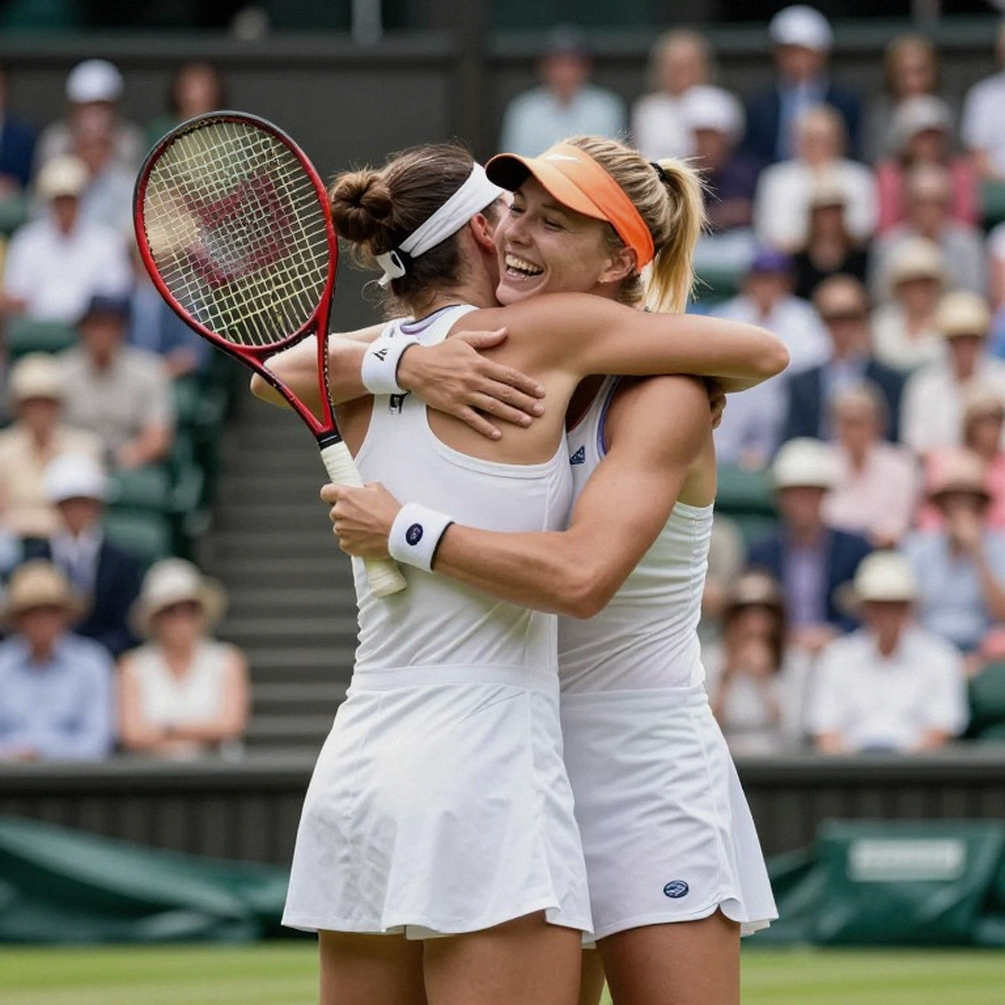
When a player finally wins a Grand Slam after years of waiting, the natural media reaction is to tie him to a completed story: the old label torn off, the gap filled, the career rewritten. But sport rarely runs on that logic of completion. The first breakthrough is often not the peak, but the start of a new set of pressures.
For Zverev, if that season is real, what disappears is not only the "great but Slam-less" label. What also disappears is the freedom of someone with nothing left to lose. Once he has won two majors in a year, the expectation shifts from whether he can win to how many more he must win. The second question is far harder to live with.
There is another technical angle worth raising. For years, Zverev's chronic weakness was his second serve and double-fault volatility under pressure in the closing stages. That is why he often lost matches he controlled for most of the duration. If the report is right, the two facts against that weakness are the 7-2 tiebreak and the 6-2 fourth set. Both are the highest-pressure moments, and both were handled cleanly.
But I do not want to conclude too quickly. Two facts in one report are not enough to erase a pattern built over years. If I have only the scoreline and not the second-serve rate or double-fault count, I cannot claim the weakness has vanished. I can only say the scenario describes a Zverev different from the one I have followed.
That is the reminder I always give myself: results tell you who won, but rarely why. To know why, you need process data. And the process data is not in the report.
Meanwhile, the Shelton story poses a different kind of pressure. His status as the first American man in a Grand Slam final since Roddick in 2026 is a real milestone, but it is also a media trap. One final does not make a champion. It makes him a bearer of expectations. And in the US, the expectations placed on a men's player trying to restore national glory can weigh more than any opponent across the net.
I have seen this kind of pressure in another sport. After one athletics final, a young athlete was dubbed the successor by the media, and over the next two seasons she never again touched her old form. Not because she got weaker, but because she began running to protect an image instead of running to win. Expectation does not create speed; it creates weight. An arena is not big because of its seats; it is big because of the stories brave enough to stay.
For Shelton, if the scenario is real, what he takes from the final is not just a runner-up finish. He takes a story. And that story will follow him through every tournament, until an American man actually wins a Grand Slam.
Back to the ranking story. If that season is real, Zverev faces the largest points-defence cliff of his career. Winning two majors plus a final in one year means he must replicate those results over the next 52 weeks to hold his position. In ATP history, replicating such a three-major season is extraordinarily rare. The phenomenon has a name: the points-defence cliff. It explains why many players with breakout seasons free-fall the following year, even when their form has not actually declined.
That is why I always look at ranking points with two eyes. Points show accumulated results, not foundation. A player can rise to world No. 1 on one breakout season then return to his true position when the points drop off. Conversely, a player who holds a high position for years, with evenly distributed points, usually reflects genuine stable quality.
And this is the whole crux. This is where I must return to what I said at the start, because it is the most important part of any analysis of this report.
The entire story above stands on an unverified assumption. The results of Zverev winning the 2026 US Open, the 2026 French Open and reaching the 2026 Wimbledon final do not align with most of the information circulating about that season. The report names no outlet, cites no source, and carries no publication date. Every fact bears a blank source label.
In my profession, a fact without a source is not a fact. It is a claim. And a claim without a source, however beautiful, should be read as a hypothesis requiring verification, not a truth to spread.
I once made the opposite mistake. In 2026, I rushed to publish an unverified detail about an athlete's record and had to correct it the next day. The lesson was not in the correction but in understanding that speed is no ally of accuracy. In an industry where everyone races to publish first, the one who publishes correctly is often the one who arrives late. And that is fine.
So I choose to read this report as a hypothetical scenario of high analytical value. It gives me a chance to ask better questions: what makes a three-surface season? What separates a player who can win on clay, grass and hard court from one who is only good on one surface? And why does the first breakthrough often bring greater pressure than all the waiting years?
The answer to the first question lies in the portability of weapons. A player who can carry his weapons across three surfaces owns something that does not depend on the surface: a stable serve and a first strike after it. On clay, points come from endurance and spin. On grass, from serve and speed. On hard court, from a balance of the two. A player good on only one surface usually collapses when conditions change. A player with portable weapons does not.
That is why, if that scenario is real, Zverev's breakthrough is not on one surface. It sits in the fact that he finally proved his weapons are not bound to playing conditions.
The answer to the second question is more complex. Modern sport is increasingly specialised. Young players are trained to optimise for one surface very early, because the rewards come faster. But that specialisation has a price: it creates narrow careers, where a player peaks on one surface then disappears when the season turns.
A three-surface season, if real, is a rebellion against that trend. It shows a player willing to bear the cost of transition — from clay to grass to hard court — while maintaining form. The cost is not small: changes in contact point, in movement rhythm, in how the ball is read. Maintaining form across three transitions in a single season is an achievement of conditioning and mentality more than pure technique.
And the answer to the third question is what I want to keep. The first breakthrough frees a player from an old burden, but at the same time places a new one on his shoulders. After winning, the pressure does not vanish; it changes shape. Before, the question was whether he could win. Now, the question is whether he can keep winning. The second question has no finish line.
That is why I do not want to read this report as an ending. I want to read it as an opening chapter. Because the most interesting thing in sport is not the moment someone crosses the line, but what happens after they cross it and discover the track is still long.
I close the laptop. Outside, Haiphong is already late. I reopen the paper file, write the names Alexander Zverev, Ben Shelton, Andy Roddick three times each, and check every letter. The old habit is still there, and I think it always will be. Because in an industry where everything can be rewritten in seconds, the only thing that keeps its value is accuracy.
There is a line I keep from the days I still ran on the track: the one who finishes right is the one who runs the right course, not the one who runs fastest. With this report, I do not yet know who ran the right course. I only know I am not allowed to say who won until there is a source strong enough to vouch for it. And until then, I keep my question open.